Small gestures, lasting memories
Is naming a star a good gift? Pros, cons and who it suits
Yes, naming a star can be a good gift, but only for the right person and only if you present it for what it is. It works best for people who keep sentimental things, love the story behind a present or enjoy looking up at night. It disappoints when someone expects astronomers to use the name, wants an object to unwrap or assumes the star will always be visible. A Starry Memory certificate is a symbolic dedication in a private registry: a real catalogued star, the words you choose and a two-page PDF. This guide sets out the real pros, the real cons and a simple test to help you decide.
A symbolic dedication in our private register.
The short answer: a good gift when the words matter more than the object
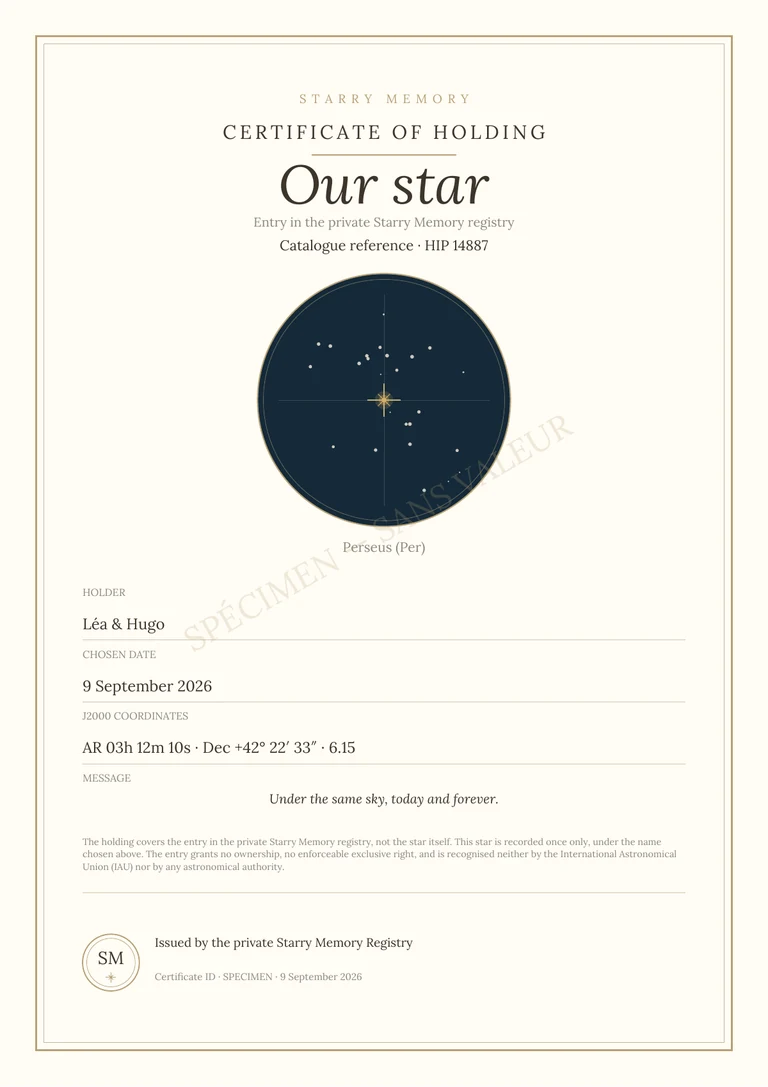
Start with what the gift actually is. You choose a real star from the Hipparcos catalogue, give it a name of up to 32 characters, add the recipient, a date and an optional message of up to 280 characters. You receive a two-page A4 PDF: a numbered certificate showing the star’s HIP reference, constellation, coordinates and magnitude, and a finder guide explaining where to look. A QR code on the certificate opens the “My star” page in a phone browser, with no app to install. The star is assigned to a single order in the private Starry Memory registry.
What it is not matters just as much. The name you choose stays on the certificate and in our registry; astronomers keep using the star’s scientific designation, and no company can change that. Nobody can sell a star in the literal sense: you pay for a personalised certificate and a symbolic dedication. Nothing arrives by post, there is no frame, and nothing is emailed to the recipient automatically.
So the real question is whether this person will value the words and the gesture. A star with the date you met and a sentence only the two of you understand can be moving; a generic line is easy to forget.
The pros: why people enjoy receiving a named star
It is personal. The name, the date and the message are yours, and the date can be anything between 1900 and 2100: a birth, a first meeting, a wedding, the day someone moved abroad. Few gifts let you write a whole memory into the present itself.
It is fast and weightless. There is no production and no shipping: the PDF is available on the confirmation page as soon as payment is verified and the star is assigned. That helps when you are late or when the person lives far away, and it can be printed at home the same evening.
It points to something real. The star exists and can be identified by its catalogue reference. With the finder guide and the “My star” page, which uses the phone’s sensors to show the star’s direction, the gift can become an evening outside together rather than a file that is opened once.
It adapts to many occasions, from a joke between best friends to the birth date of a baby. You also control privacy: public display of the star name is off by default, and the recipient and the message are never published.
The cons, said plainly
It is symbolic. The international body that names stars for astronomers does not sell names, and a name bought from any company is not used in science. Several companies keep their own private lists, so a star in our registry could appear in another seller’s list too. Our commitment to assign each star to one order covers our registry only. If the recipient would feel misled on discovering this later, say it on the card from the start.
Seeing the star is never guaranteed. A star fainter than magnitude 6 needs binoculars even under a dark sky. City lights, the Moon, clouds, the season and the time of night all change what is visible. Hemisphere matters too: a star chosen for the northern sky may never rise above the horizon in Sydney or Auckland, and the Southern Cross never rises in London.
It is a file, not a parcel. Some people love to unwrap something. If that is the person you are buying for, plan to print the certificate on good paper, slide it into an envelope or a frame you buy separately, or pair it with a small object that links to the memory.
It has a reputation to overcome. Some people have read that star naming is a scam, usually because certain sellers implied that the name would be recognised by scientists. If your recipient is sceptical, a clear, honest explanation helps more than any decoration, and our page on whether buying a star is real answers that question in detail.
Who it suits, and who it does not
It usually suits the sentimental keeper: the friend who saves concert tickets, letters and birthday cards. It suits couples with a date that matters, new parents who will read the certificate to their child one day, grandparents who enjoy a story they can show visitors, and people who live far from you, because the PDF arrives on time wherever they are. It can suit a family remembering someone, when you already know a keepsake would be welcome. And it suits a curious child, provided an adult turns it into a short evening of looking at the sky.
It is often the wrong choice for someone who only values practical gifts, or for a colleague you barely know, because a dedication can feel too intimate. It may annoy a keen amateur astronomer who dislikes commercial star naming, unless they enjoy the gesture and you are open about what it is. For someone who is grieving, wait until they have said that a keepsake would help; a star offered too early can feel like a decision made for them.
A quick example. Your sister keeps every ticket from the concerts you went to together: a star dated to your first one, with a line about the song you both sang badly, will probably land well. Your new manager, whom you met three weeks ago: choose something else.
Three questions to ask before you buy
Can you write two true sentences about this person? If nothing specific comes to mind, the certificate will feel empty. A real detail, a place or a phrase they always say makes the gift work.
Will they understand what it is? Add one plain line to your card, for example: “This is a symbolic gift: a real star, our words and a reason to look up together.” People rarely mind that a dedication is symbolic; they mind discovering it later.
Do you want them to see it? If so, choose the “Visible to the naked eye” level, which means magnitude 6 or brighter, check that the star rises in their part of the world, and use the free star map to look at the sky of their location on a given date. Even then, a dark, clear night remains the condition, and seeing it is never guaranteed.
How to make it better than the cliché
Write something only you could write. Instead of “you are my star”, try a scene: the night you got lost on the way home, the walk where they told you about their new job, the first word their baby said. Two or three short sentences are enough.
Choose a date and a star with intention. For a birthday, a constellation well placed in their evening sky at that time of year makes the search easier: Orion on winter evenings in the northern hemisphere, the Southern Cross for someone in Australia or New Zealand. If the date is their birthday, our free page about the night sky on the day you were born shows what the sky looked like that night, which can be a lovely companion to the certificate.
Present it well. Read the PDF first, then print it on heavier matte paper for an envelope, or open it together on a call and explain why you chose that memory. A plan for an evening outside with the finder guide turns the gift into an experience.
Good alternatives if a star is not right
If the sky of a moment matters more than one star, a personalised sky-map poster shows the whole sky calculated for a date and a place, such as the night you met or the night they were born. If you only want to share the idea without spending anything, the free star map lets you show them the sky of a date and place on screen.
For a stargazer, an experience may suit better: an evening at a dark-sky site, a planetarium visit or a local astronomy club night. Binoculars make a good first instrument; never point them towards the Sun.
Frequently asked questions
Is a named star a thoughtful gift or a gimmick?
It depends on the words. The star is real and identified by its Hipparcos catalogue reference; the name is a symbolic dedication. With a specific memory and an honest explanation, many people find it touching. With a generic message, it can feel like a gimmick.
Will the star really be named after them?
Only on the certificate and in the private Starry Memory registry. Astronomers keep using the star’s scientific designation, such as its HIP number, and no company can change that.
Will they be able to see their star?
Possibly. Choose a star of magnitude 6 or brighter that rises in their hemisphere, then look from a dark place on a clear night. The “My star” page shows its direction with the phone’s sensors. Visibility is never guaranteed.
Is it a good gift for someone who has lost a loved one?
It can be, when you know a keepsake would be welcome and you leave them free to keep it private. Our page on naming a star in memory explains the gift, and our memorial guide suggests gentle words.
What does the person actually receive?
A two-page A4 PDF: the numbered certificate with your name, recipient, date and message, and a finder guide. A QR code opens the “My star” page in a phone browser. There is no parcel and no frame.
How much does it cost to name a star?
The price depends on the level of the star, mainly its brightness and type, and the total is shown before payment. Our price page lists every level. Prices are charged in euros, and your bank converts other currencies.
Before preparing your gift
- I can write two true sentences about this person.
- They will understand that the gift is a symbolic dedication.
- If seeing the star matters, I chose one they can look for from where they live.
- I checked the total price on the payment page before paying.
- I will download and read both pages of the PDF before giving it.