Step-by-step guide · name a star
How to name a star, step by step
Naming a star takes a few minutes: you pick a real star from the Hipparcos catalogue, give it a name, write your dedication, check the free preview, and the PDF certificate downloads as soon as you pay, from €8.91.
- Five steps, from a phone or a computer.
- The certificate preview is free: you see everything before paying.
- The two-page PDF downloads as soon as you pay, with no parcel and no subscription.
Symbolic dedication in the private Starry Memory registry · from €8.91 · PDF to download as soon as you pay.
Giving a star: how it works
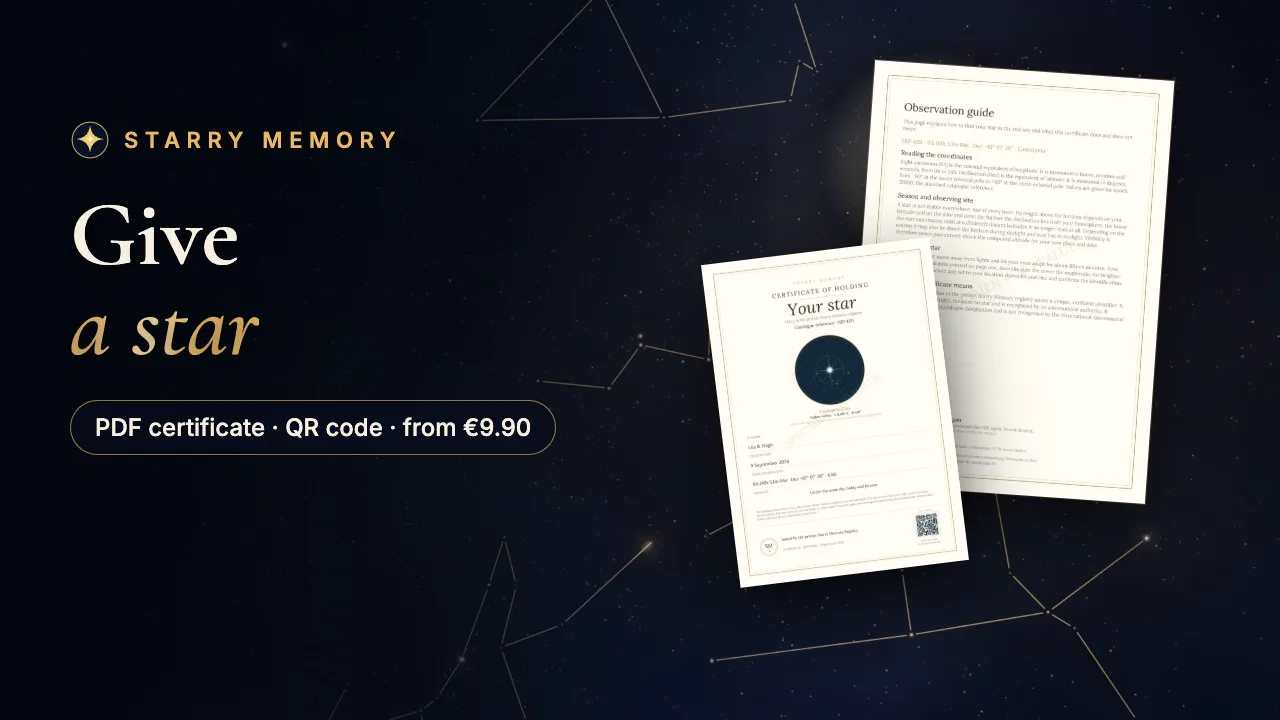
A real star, its personalised PDF certificate and a QR code to find it in the sky.
To be clear from the start: this is a symbolic dedication in the private Starry Memory registry. The name you choose appears on your certificate and in our registry; it does not replace the star’s scientific designation, and astronomers will not use it. This guide walks through each step, what you receive and the mistakes to avoid.
What to prepare before you start
Nothing technical. Just jot down in advance, on your phone for instance:
- the star name, up to 32 characters: a first name, a nickname, two names joined together;
- the recipient, up to 60 characters: the person or the family you are dedicating the star to;
- the date to remember, between 1900 and 2100: a birth, a first meeting, a wedding. It can differ from the day you buy;
- an optional message, up to 280 characters: two or three sentences are enough.
The 5 steps to name a star
The star chooser groups these steps into three screens: the star, the dedication, then payment. You can go back at any time.
Pick the star in the sky
When the chooser opens, an available star is already proposed, chosen for your hemisphere from your device’s time zone. You can simply keep it.
Otherwise, tap another star on the 3D sky, or search by constellation, name or HIP number. Each star card shows its constellation, magnitude and price; a star marked “Already dedicated” can no longer be chosen.
Choose the level
Three levels share the sky, each in its own colour: “Catalogue star” at €8.91, “Visible to the naked eye” at €17.91 and “Remarkable white star” at €44.91. Rarer stars, up to €2,241, are in the explorer.
Tapping a level lights up its stars and takes you to the best available one. To look for the star outdoors, choose at least “Visible to the naked eye”: magnitude 6 or brighter.
Write the name and the dedication
On a single screen you fill in the star name, the recipient, the date and, if you wish, a message. The certificate updates as you type.
Choose the colour, ivory, midnight or rose, all at the same price. Public display of the star name is off by default; the recipient and the message are never published.
Check the preview
The free preview shows your personalisation on the certificate; its unique number is added after payment. Check spelling, capitals and the date.
On a phone, tap “Show preview”. The next screen sums up the star, the colour and the total price before any payment; you can still change star there.
Pay and download the PDF
The total is confirmed on the secure Stripe payment page. Because the certificate is digital content supplied straight away, a tick box asks you to accept immediate delivery.
As soon as payment is verified and the star is assigned, the PDF is available on the confirmation page. Download it and keep its private link: nothing is sent by post or automatically to your inbox.
How long does it take to name a star?
A few minutes if your words are ready. The star is proposed straight away; the message takes longest, and that is how it should be: the message is what makes the gift.
There is no production and no shipping: the PDF exists as soon as payment is confirmed. You can prepare the gift the night before, on the day itself or from far away. Just allow time to print it.
What you receive, exactly
A two-page A4 PDF, designed to be printed or given as it is:
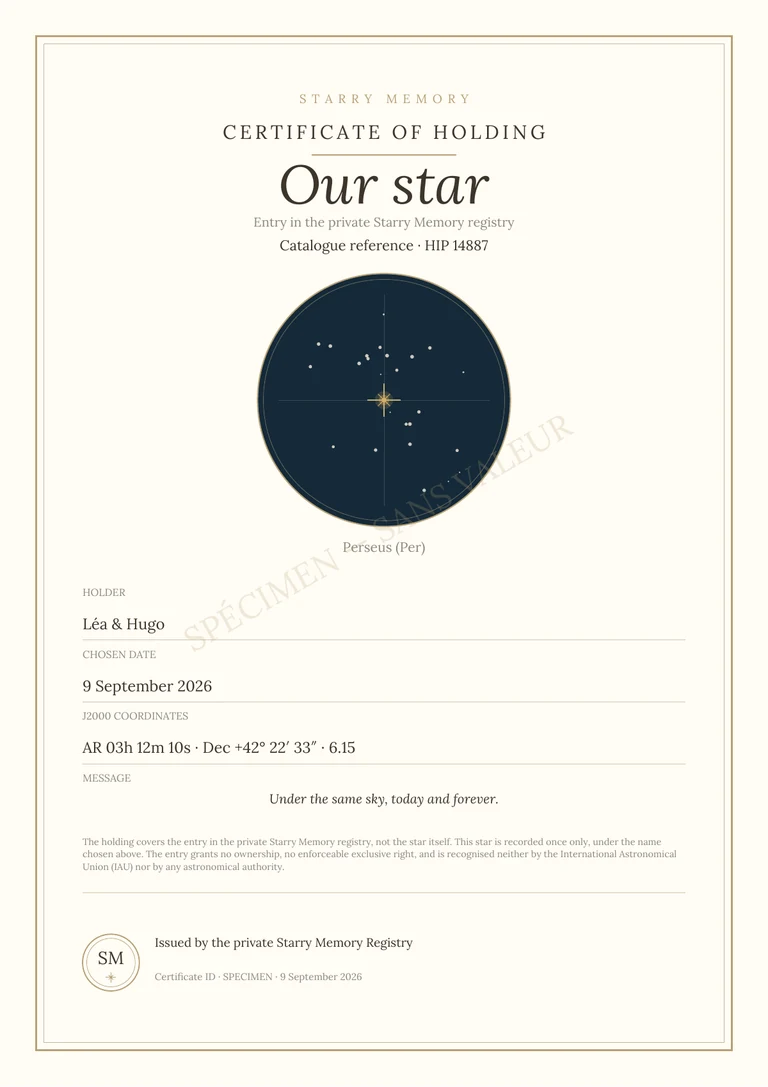
- page 1, the numbered certificate: the star name, the recipient, the date and your message, with the star’s scientific identity (HIP reference in the Hipparcos catalogue, constellation, coordinates, magnitude);
- page 2, a finder guide showing where and how to look for the star;
- a QR code that opens the “My star” page in the phone’s browser, with no app: the star in 3D, then help to find it in the real sky with the phone’s sensors. The recipient and the message never appear there;
- the assignment of this star to a single order in the private Starry Memory registry.
How to choose a star that means something
The best star is not always the brightest: it is the one the person can link to their own story. Three approaches work well.
The sky above their home. From the UK, Ireland, Canada or the northern United States, Cassiopeia, shaped like a W, never sets: you find it towards the north on every clear night. The Plough, or Big Dipper, in Ursa Major, is visible all year towards the north too. In the southern hemisphere, in Australia or New Zealand for example, choose the Southern Cross or Centaurus.
The date. For a birthday, pick a constellation well placed in the evening at that time of year: Orion in winter, Leo in spring, Lyra and Cygnus in summer, Pegasus in autumn (northern seasons). Avoid the constellation of their zodiac sign: around their birthday, the Sun is in or near that part of the sky, which makes it hard or impossible to see that night.
Brightness. To look for it together outdoors, choose a star of magnitude 6 or brighter and a dark sky, away from street lights. For a couple or for siblings, two stars in the same constellation make a lovely pair.
Which constellation for which season?
Constellations that are easy to recognise from the northern hemisphere, plus one from the southern sky, with the number of stars in our registry and those of magnitude 6 or brighter. Each link opens the chooser on that constellation.
| Constellation | When to look (evening, northern hemisphere) | Stars in the registry | Naked-eye stars among them | Choose a star |
|---|---|---|---|---|
| Cassiopeia | All year, towards the north | 16 | 7 | Choose a star |
| Ursa Major | All year, towards the north; high in spring | 30 | 26 | Choose a star |
| Leo | Spring evenings, towards the south | 29 | 23 | Choose a star |
| Lyra | Summer evenings, very high, around Vega | 4 | 3 | Choose a star |
| Cygnus | Summer and autumn evenings, very high | 22 | 14 | Choose a star |
| Pegasus | Autumn evenings, towards the south | 22 | 13 | Choose a star |
| Orion | Winter evenings, towards the south | 20 | 15 | Choose a star |
| Crux | Southern hemisphere only: not visible from Europe, Canada or most of the United States | 5 | 3 | Choose a star |
Catalogue figures at the date this page was updated: a star already dedicated is no longer offered, and real availability is shown in the chooser.
Visibility is not guaranteed: the place, the date, the time, the weather, the Moon and light pollution decide what you can see.
10 example names and dedications
The name is short; the message says why. Examples to adapt with a true detail, a place, a habit:
The recipient is a separate field: for a shared gift, write “For the Jones family”, for instance. If you turn on public display, only the star name is shown, so keep it free of anything too personal.
Mistakes to avoid
Disappointment nearly always comes from a misunderstood promise or a pointless extra.
Believing astronomers will adopt the name
No website can put a name into the scientific catalogues. The International Astronomical Union (IAU) names stars under its own rules and does not sell names; Starry Memory is not affiliated with it.
Present the gift as what it is: a symbolic dedication, with a real star you can look for. It is accurate, and it is what touches people.
Paying for “insurance” or a “name deposit”
Some offers add, for an extra fee, insurance, a reinforced registration or a “copyright” on the name. These options give the name no legal or scientific value.
Decline them. What matters: a verifiable catalogue reference, coordinates and a total price shown before payment.
Paying for paper delivery you do not need
A printed, posted certificate adds shipping costs and several days of waiting, sometimes for a simple print.
Print the PDF yourself or at a print shop on matte paper of 160 to 250 g/m², then slip it into an envelope or a frame.
Choosing a star without checking its magnitude
Fainter than magnitude 6, a star needs binoculars, even under a dark sky. With the “Catalogue star” level, naked-eye visibility is not guaranteed.
Check the magnitude on the star card before confirming; for a stargazing evening together, aim for 6 or brighter.
Letting a typo slip through
The PDF reproduces exactly what you typed, accents and capitals included.
Read the preview out loud and check the date before paying.
Frequently asked questions
Can you name a star for free?
The certificate preview is free, with no account to create; the certificate itself costs from €8.91. No process, free or paid, gets a star name adopted by astronomers.
How long does it take to name a star?
A few minutes. The star is proposed straight away, the dedication fits on one screen and the PDF downloads as soon as payment is verified and the star is assigned.
Will the star name be recognised?
No, and no website can promise it. The name lives on your certificate and in the private Starry Memory registry; astronomers keep using the star’s scientific designation, such as its HIP number.
Can two people have the same star?
Not in our registry: each star is assigned to a single order there, and a star already dedicated is no longer offered. This commitment covers our registry only; other websites keep their own lists.
How will the person find their star?
With the finder guide and the certificate’s QR code, which opens the “My star” page and helps locate it with the phone’s sensors. Naked-eye visibility depends on the magnitude, the place, the time and the weather: it is never guaranteed.
Can I name a star after someone who has died?
Yes. The name can be their first name or the nickname you gave them, and the date their birthday or a happy memory. Our page on naming a star in memory suggests gentle words for that moment.
Written by Mathis Delolmo, founder of Starry Memory. About us (in French) · Updated 8 November 2026
✦ Personalised star certificate
Give a star, scan it and find it in the sky with your smartphone
A personalised certificate with a QR code: one smartphone scan shows the star in 3D, then its direction in the real sky.
- Choose a real star and its name
- Scan the certificate’s QR code, no app needed
- Find it in the sky with your smartphone
From €8.91 · PDF to download as soon as you pay
Symbolic dedication in the private Starry Memory registry. Depending on its brightness and the weather, you’ll see it with the naked eye, with binoculars, or find its direction.