Small gestures, lasting memories
How to find your dedicated star in the night sky
To search for a dedicated star, start with its scientific identifier, not the personal name of the certificate. Sky map software can help you locate the target, and then on-site conditions determine what you will actually see.
A symbolic dedication in our private register.
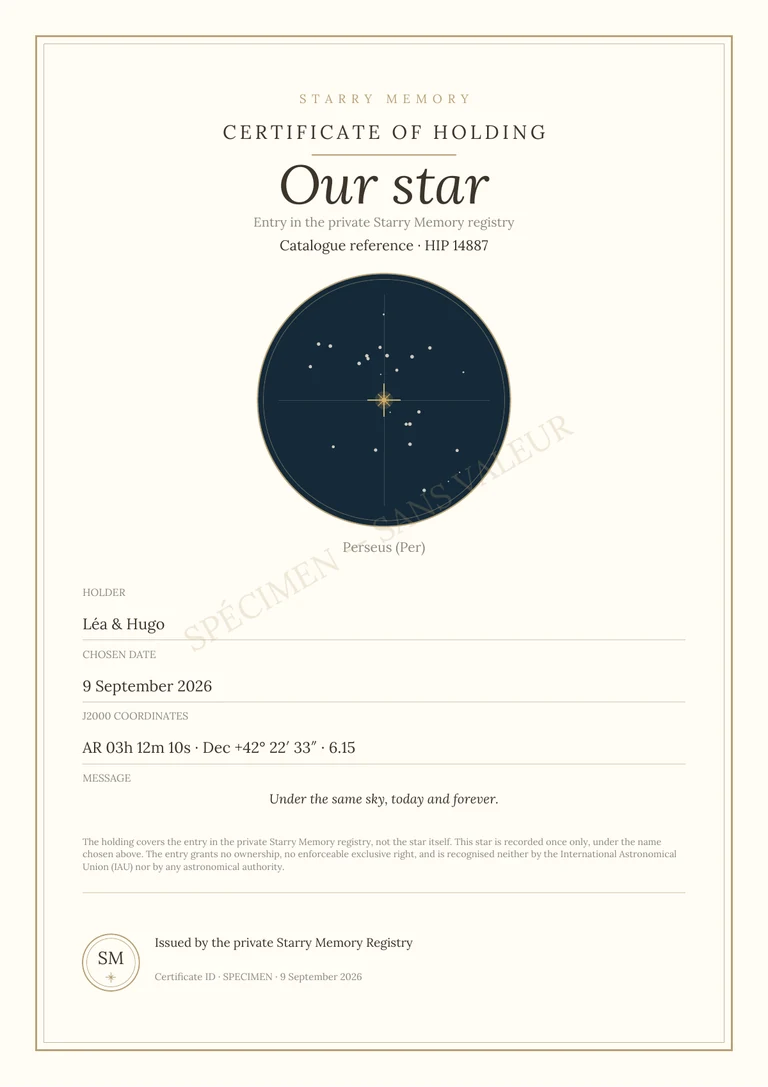
Gather the star’s details before heading outside
Note the HIP reference and coordinates printed on the certificate. Right ascension and declination describe a celestial position; the mention J2000 indicates the reference epoch of the coordinates. In your sky map, set the observation location, date and local time, checking the time zone. Search for the ID if the app supports it and check the details of the matching star. The private dedication name is not necessarily known to the software.
Check the horizon, weather and light pollution
Look to see if the star is above the horizon and in an unobstructed direction. A building or terrain can obscure what the map represents. Check the weather forecast and choose a place away from direct artificial light; then let your eyes adjust to the darkness. Some stars require binoculars or a telescope, but no instrument removes clouds or an unfavorable horizon. If the target is too low or the night too bright, try another night rather than guaranteeing a sighting.
Make looking for the star part of the experience
First locate a recognisable constellation, then progress towards the area sought with the map. For a first outing, the help of an astronomy association can be useful. With children, keep an adult present and keep the outing short enough for them. Never point binoculars or telescopes towards the Sun. You can note location, time and conditions to prepare for a new attempt. The certificate and its guide provide a starting point; the dedication does not grant any guarantee of permanent visibility or from all countries.
Before preparing your gift
- Record the HIP identifier and the time of the coordinates.
- Set location, date, time and zone in the map.
- Control horizon, weather and ambient light.
- Adapt the instrument and never aim at the Sun.