Star naming prices · full list
How much does it cost to name a star? Real prices, explained
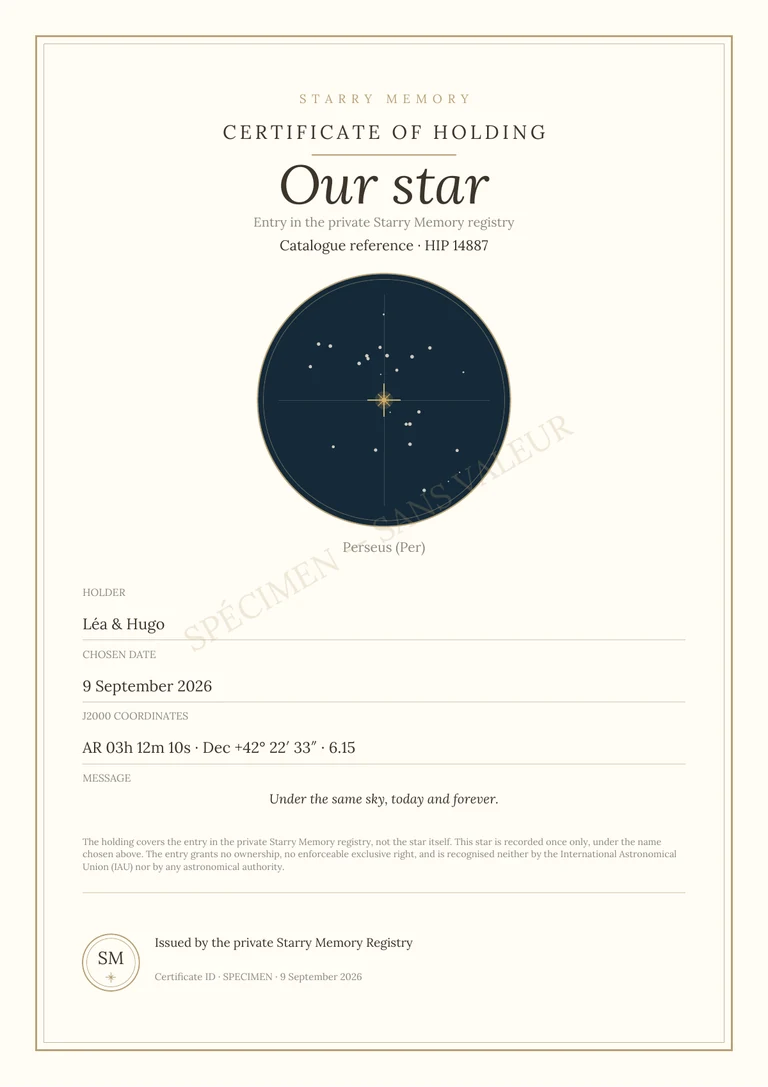
At Starry Memory, naming a star costs from €8.91. The price depends on how bright the star is (its magnitude) and what type of star it is. Nobody sells stars in the literal sense: you pay for a personalised certificate and a symbolic dedication in our private registry.
Symbolic dedication in the private Starry Memory registry · from €8.91 · PDF to download as soon as you pay.
Below is our entire price list, calculated from the 1,024 real stars in the registry: 13 levels, from €9.90 to €2,490. Few star registries publish theirs; we would rather you knew exactly what changes the price before you choose.
During the Eclipse year, a 10% benefit is deducted automatically from the catalogue price of every level; your total is always confirmed before payment.
The price list, level by level
Every star in the registry belongs to exactly one level. The table shows how many stars each level holds, the range of their magnitudes, and whether you can see them with the naked eye under a dark sky. The three most popular levels open straight into the quick choice; the others can be browsed in the 3D explorer.
| Level | Stars in the catalogue | Magnitude | Naked eye, dark sky | Catalogue price | With the 10% benefit | Choose |
|---|---|---|---|---|---|---|
| Catalogue starA real Hipparcos star with no particular documented astronomical profile | 540 | 4.01 – 9.95 | Possible: 375 of 540 | €8.91 | Choose | |
| Faint starMagnitude between 6 and 8: binoculars needed | 40 | 6.02 – 7.78 | No, needs an instrument | €13.41 | Browse | |
| Naked-eye starMagnitude 6 or brighter, no other particular profile | 95 | 4.04 – 5.99 | Yes | €17.91 | Choose | |
| White star (type A)Referenced spectral type A, fainter than magnitude 6 | 13 | 6.01 – 7.82 | No, needs an instrument | €26.91 | Browse | |
| Remarkable white starSpectral type A, magnitude 6 or brighter | 57 | 4.06 – 5.94 | Yes | €44.91 | Choose | |
| Blue star (type B)Referenced spectral type B, fainter than magnitude 6 | 3 | 6.15 – 6.98 | No, needs an instrument | €71.91 | Browse | |
| Visible blue starSpectral type B, magnitude 6 or brighter | 48 | 4.08 – 5.78 | Yes | €116.10 | Browse | |
| GiantExplicit luminosity class III, fainter than magnitude 6 | 35 | 6.02 – 9.39 | No, needs an instrument | €224.10 | Browse | |
| Visible giantExplicit luminosity class III, magnitude 6 or brighter | 164 | 4.01 – 5.99 | Yes | €449.10 | Browse | |
| SupergiantExplicit luminosity class I, fainter than magnitude 6 | 7 | 7.05 – 9.97 | No, needs an instrument | €674.10 | Browse | |
| Visible supergiantExplicit luminosity class I, magnitude 6 or brighter | 19 | 4.03 – 5.69 | Yes | €891 | Browse | |
| Dossier: type O starA very hot star documented individually by cited publications | 1 | 9.02 | No, needs an instrument | €1,431 | Browse | |
| Individual dossierAn entry documented individually by cited publications | 2 | 6.73 – 7.29 | No, needs an instrument | €2,241 | Browse |
Star counts are those of the catalogue on the date this page was last updated, not live availability: a star that has already been dedicated is no longer offered. The exact amount for the star you pick is shown before payment and confirmed on the secure checkout page.
Prices are charged in euros. If your card is in pounds, dollars or another currency, your bank converts the amount at its own rate and may add a fee.
These prices are set by Starry Memory for the certificate and the assignment in its private registry. They are not a valuation of the star, an investment value or a measure of rarity.
What makes one star cost more than another
Magnitude measures how bright a star looks from Earth: the smaller the number, the brighter the star. Magnitude 6 is roughly the faintest a human eye can see under a truly dark, rural sky. That is why, for the same profile, a star of magnitude 6 or brighter costs more: it is a star you can actually go outside and look for together.
Spectral type classifies stars by temperature. Type A stars (white, like Vega and Sirius) and type B stars (bluish, hotter still) are less common in the registry and have levels of their own. Giants (luminosity class III) and supergiants (class I) are ageing stars many times larger than the Sun; a star is only classed that way when the class is explicitly documented in reference publications, through the SIMBAD database.
Finally, a few entries have an individual dossier documented by cited publications, including a type O star, among the hottest known: they are the highest levels on the list.
- Magnitude 0 to 1: the brightest stars in the sky, such as Vega. They already carry proper names and are not in the registry, whose stars range from magnitude 4.01 to 9.97.
- Magnitude 4 to 5: visible from a small town or a back garden on a clear night.
- Magnitude 5 to 6: visible under a properly dark country sky, once your eyes have adjusted.
- Magnitude 6 to 8: you will need binoculars.
- Magnitude 8 to 10: good binoculars or a small telescope.
Why a €9.90 star is not always visible
The “Catalogue star” level gathers real stars with no particular documented profile, at every brightness: of its 540 stars, 375 have a magnitude of 6 or brighter, while the rest need binoculars or even a telescope. With the quick choice at this price, brightness is not a criterion, so naked-eye visibility is not guaranteed.
If seeing the star matters — looking for it together on a summer night, showing it to a child — choose the “Naked-eye star” level instead, at €19.90 catalogue price: we pick the brightest available star of that level for your hemisphere. In the 3D explorer, every star also shows its magnitude before you choose it.
Whatever you pick, weather, moonlight, street lighting and the time of night decide what you can see. The finder guide on the second page and the certificate’s QR code at least show the star’s direction from wherever you are standing.
What you actually pay for
Whatever the level, the price covers the same things:
- a numbered two-page A4 PDF certificate, to download as soon as you pay, with the chosen name, the date and your message;
- a real star referenced in the Hipparcos catalogue (HIP number), with its coordinates and astronomical data;
- a finder guide and a QR code that opens the star’s page in 3D, then helps you find it in the sky, with no app to install;
- the assignment of that star to a single order in the private Starry Memory registry;
- a choice of three colours at the same price: ivory, midnight or rose.
What the price does not include
You are not paying for ownership of the star or for a name astronomers will use: only the International Astronomical Union assigns star names, and it sells none. Starry Memory is not affiliated with it. Your chosen name lives in our registry and on your certificate, not in scientific catalogues.
Nor does the price include printing, a frame or postage: it is a digital product. That is also what keeps the entry price low, and the gift ready in minutes.
How to compare star registry prices
Star naming offers vary widely in price, often for very similar content. Rather than the headline figure, compare what it covers:
- Is the full price shown before payment, including shipping and add-ons?
- Is it a file, a print or a boxed kit? Postage can cost as much as the certificate itself.
- Is the star identified by a checkable catalogue number (HIP, HD) and coordinates?
- Is its brightness stated, so you know whether you will be able to see it?
- Is the symbolic nature said plainly, with no promise of an “official” or “registered” name?
- Is there a subscription or an automatic renewal hidden in the small print?
Frequently asked questions
Can you name a star for free?
No procedure makes a star name official, free or paid: the International Astronomical Union assigns names by its own rules and sells none. Private registries, free or paid, offer a symbolic dedication. At Starry Memory the certificate preview is free; the certificate itself costs from €8.91.
How much does NASA charge to name a star?
Nothing, because NASA does not name stars and does not sell them. Any offer that claims a link with NASA or official recognition is misleading.
Does the certificate colour change the price?
No. For the same star, ivory, midnight and rose cost exactly the same.
Can I name several stars?
Yes. Each star has its own certificate and is ordered separately; for a couple or siblings, two stars in the same constellation make a lovely pair.
Can I get a refund?
The certificate is personalised digital content supplied immediately: by requesting immediate supply at checkout, you give up the right of withdrawal once the download begins, as our terms of sale explain. The free preview is there so you can check everything before you pay.
Written by Mathis Delolmo, founder of Starry Memory. About us · Updated 30 September 2026
✦ Personalised star certificate
Give a star, scan it and find it in the sky with your smartphone
A personalised certificate with a QR code: one smartphone scan shows the star in 3D, then its direction in the real sky.
- Choose a real star and its name
- Scan the certificate’s QR code, no app needed
- Find it in the sky with your smartphone
From €8.91 · PDF to download as soon as you pay
Symbolic dedication in the private Starry Memory registry. Depending on its brightness and the weather, you’ll see it with the naked eye, with binoculars, or find its direction.