- 9 h
October 2026 moonless nights in Tampere
Tampere · FI · October 2026
Choose a night to see more stars
Use the Moon’s absence to plan a look at the stars. Start with the suggested time below, then explore other dates.
Your first step
- What to look for
- Stars and the patterns they form. Without a bright Moon in the sky, fainter stars are easier to spot.
- When to go
Night beginning Fri 16 Oct
- 9 h
- Where to look
- Look across an open sky, away from bright lamps. There is no single direction to follow for this outing.
- What you need
- Your eyes are enough to start. Give them time to adjust to the dark and keep your phone screen dim.
All times are local to Tampere (Europe/Helsinki).
This is the longest unbroken moon-free period calculated for the month. It is a starting point, not a forecast of the best weather.
Before setting out, check the clouds and find a view clear of buildings and trees. These times do not guarantee what you will see.
Three nights to consider
These nights have the longest unbroken moon-free periods. Pick one that suits you and the weather; you do not have to stay for the whole period.
October at a glance
Each square shows the number of moon-free hours. Choose a date, then open its row below for the times. Darker green means more time, not better weather.
- 10
- 20
- 30
- 41.75
- 53.75
- 65.5
- 77.25
- 88
- 98.25
- 108.5
- 118.5
- 128.5
- 138.75
- 148.75
- 158.75
- 169
- 179
- 187.5
- 196
- 204.5
- 212.75
- 221.5
- 230
- 240
- 250
- 260
- 270
- 280
- 290
- 300
- 310.75
NoneMore hours
All 31 nights: open a date
Open a date for the full timetable. The date names the evening when the night begins; hours after midnight show the next date.
Night beginning Moon-free intervals: 0 min
Moon-free intervals
No moon-free time is listed for this night. You may still see bright stars or planets.
When the sky is fully dark
- Darkness begins
- Morning light begins
Moon at
69.9% illuminated · waning
Night beginning Moon-free intervals: 0 min
Moon-free intervals
No moon-free time is listed for this night. You may still see bright stars or planets.
When the sky is fully dark
- Darkness begins
- Morning light begins
Moon at
58.9% illuminated · waning
Night beginning Moon-free intervals: 0 min
Moon-free intervals
No moon-free time is listed for this night. You may still see bright stars or planets.
When the sky is fully dark
- Darkness begins
- Morning light begins
Moon at
47.5% illuminated · waning
Night beginning Moon-free intervals: 1 h 45 min
Moon-free intervals
- 1 h 45 min
When the sky is fully dark
- Darkness begins
- Morning light begins
Moon at
36.2% illuminated · waning
Night beginning Moon-free intervals: 3 h 45 min
Moon-free intervals
- 3 h 45 min
When the sky is fully dark
- Darkness begins
- Morning light begins
Moon at
25.8% illuminated · waning
Night beginning Moon-free intervals: 5 h 30 min
Moon-free intervals
- 5 h 30 min
When the sky is fully dark
- Darkness begins
- Morning light begins
Moon at
16.6% illuminated · waning
Night beginning Moon-free intervals: 7 h 15 min
Moon-free intervals
- 7 h 15 min
When the sky is fully dark
- Darkness begins
- Morning light begins
Moon at
9.3% illuminated · waning
Night beginning Moon-free intervals: 8 h
Moon-free intervals
- 8 h
When the sky is fully dark
- Darkness begins
- Morning light begins
Moon at
4% illuminated · waning
Night beginning Moon-free intervals: 8 h 15 min
Moon-free intervals
- 8 h 15 min
When the sky is fully dark
- Darkness begins
- Morning light begins
Moon at
0.9% illuminated · waning
Night beginning Moon-free intervals: 8 h 30 min
Moon-free intervals
- 8 h 30 min
When the sky is fully dark
- Darkness begins
- Morning light begins
Moon at
0.1% illuminated · waxing
Night beginning Moon-free intervals: 8 h 30 min
Moon-free intervals
- 8 h 30 min
When the sky is fully dark
- Darkness begins
- Morning light begins
Moon at
1.5% illuminated · waxing
Night beginning Moon-free intervals: 8 h 30 min
Moon-free intervals
- 8 h 30 min
When the sky is fully dark
- Darkness begins
- Morning light begins
Moon at
4.9% illuminated · waxing
Night beginning Moon-free intervals: 8 h 45 min
Moon-free intervals
- 8 h 45 min
When the sky is fully dark
- Darkness begins
- Morning light begins
Moon at
10% illuminated · waxing
Night beginning Moon-free intervals: 8 h 45 min
Moon-free intervals
- 8 h 45 min
When the sky is fully dark
- Darkness begins
- Morning light begins
Moon at
16.5% illuminated · waxing
Night beginning Moon-free intervals: 8 h 45 min
Moon-free intervals
- 8 h 45 min
When the sky is fully dark
- Darkness begins
- Morning light begins
Moon at
24.2% illuminated · waxing
Night beginning Moon-free intervals: 9 h
Moon-free intervals
- 9 h
When the sky is fully dark
- Darkness begins
- Morning light begins
Moon at
32.7% illuminated · waxing
Night beginning Moon-free intervals: 9 h
Moon-free intervals
- 9 h
When the sky is fully dark
- Darkness begins
- Morning light begins
Moon at
41.8% illuminated · waxing
Night beginning Moon-free intervals: 7 h 30 min
Moon-free intervals
- 7 h 30 min
When the sky is fully dark
- Darkness begins
- Morning light begins
Moon at
51.2% illuminated · waxing
Night beginning Moon-free intervals: 6 h
Moon-free intervals
- 6 h
When the sky is fully dark
- Darkness begins
- Morning light begins
Moon at
60.7% illuminated · waxing
Night beginning Moon-free intervals: 4 h 30 min
Moon-free intervals
- 4 h 30 min
When the sky is fully dark
- Darkness begins
- Morning light begins
Moon at
70% illuminated · waxing
Night beginning Moon-free intervals: 2 h 45 min
Moon-free intervals
- 2 h 45 min
When the sky is fully dark
- Darkness begins
- Morning light begins
Moon at
78.7% illuminated · waxing
Night beginning Moon-free intervals: 1 h 30 min
Moon-free intervals
- 1 h 30 min
When the sky is fully dark
- Darkness begins
- Morning light begins
Moon at
86.5% illuminated · waxing
Night beginning Moon-free intervals: 0 min
Moon-free intervals
No moon-free time is listed for this night. You may still see bright stars or planets.
When the sky is fully dark
- Darkness begins
- Morning light begins
Moon at
92.9% illuminated · waxing
Night beginning Moon-free intervals: 0 min
Moon-free intervals
No moon-free time is listed for this night. You may still see bright stars or planets.
When the sky is fully dark
- Darkness begins
- Morning light begins
Moon at
97.4% illuminated · waxing
Night beginning Moon-free intervals: 0 min
Moon-free intervals
No moon-free time is listed for this night. You may still see bright stars or planets.
When the sky is fully dark
- Darkness begins
- Morning light begins
Moon at
99.7% illuminated · waxing
Night beginning Moon-free intervals: 0 min
Moon-free intervals
No moon-free time is listed for this night. You may still see bright stars or planets.
When the sky is fully dark
- Darkness begins
- Morning light begins
Moon at
99.2% illuminated · waning
Night beginning Moon-free intervals: 0 min
Moon-free intervals
No moon-free time is listed for this night. You may still see bright stars or planets.
When the sky is fully dark
- Darkness begins
- Morning light begins
Moon at
96% illuminated · waning
Night beginning Moon-free intervals: 0 min
Moon-free intervals
No moon-free time is listed for this night. You may still see bright stars or planets.
When the sky is fully dark
- Darkness begins
- Morning light begins
Moon at
90.2% illuminated · waning
Night beginning Moon-free intervals: 0 min
Moon-free intervals
No moon-free time is listed for this night. You may still see bright stars or planets.
When the sky is fully dark
- Darkness begins
- Morning light begins
Moon at
82.2% illuminated · waning
Night beginning Moon-free intervals: 0 min
Moon-free intervals
No moon-free time is listed for this night. You may still see bright stars or planets.
When the sky is fully dark
- Darkness begins
- Morning light begins
Moon at
72.4% illuminated · waning
Night beginning Moon-free intervals: 45 min
Moon-free intervals
- 45 min
When the sky is fully dark
- Darkness begins
- Morning light begins
Moon at
61.6% illuminated · waning
Optional: calculation details and sources
Sun centre below −18° · Moon centre below −1°
Moon-free intervals are sampled every 15 elapsed minutes from local noon to the following noon. Both endpoint samples must have the geometric centre of the Sun below −18° and the geometric centre of the Moon below −1°. Astronomical dusk and dawn mark the Sun’s −18° crossing, rounded to the minute.
Only adjacent qualifying samples are joined. Boundaries are approximate and rounded inward to the sample grid; shorter opportunities can be omitted. An empty result means no qualifying sampled interval, not that the object never rises.
Times use the city’s IANA time zone. Each endpoint carries its actual local date and zone label, including daylight-saving changes. Durations are elapsed time, so a clock change can make wall-clock subtraction misleading. A night is named for the date on which it begins.
The Moon information is a snapshot at 22:00 local time. Phase alone does not determine a moon-free interval: the Moon must also be below the horizon while the sky is astronomically dark.
Coordinates represent the listed city, not a verified observing site. Observer elevation uses the city record where available, otherwise 0 m. Sun and Moon altitudes use a geometric horizon without atmospheric refraction.
Cloud, haze, light pollution, buildings, terrain and actual atmospheric conditions are not modelled. Check the forecast and a clear horizon before making plans; these geometric windows do not promise visibility.
- Coordinates (latitude, longitude)
- 61.49911°, 23.78712°
- Local time zone
- Europe/Helsinki
Sources and data credits
- NASA: which planets you can see
- NASA: choosing a place to see stars
- NASA: observing Saturn and its rings
- Astronomy Engine: calculation documentation
- NOAA / NWS: twilight definitions
- GeoNames: city coordinates and time zones · CC BY 4.0
City records are selected from GeoNames data, licensed CC BY 4.0. Calculations use Astronomy Engine 2.1.19; the local sampling and presentation are by Starry Memory.
Choose a dark night to look at the stars, with useful dates and times for your city.
Moonlight can hide fainter stars. Below, find times when the sky is dark and the Moon is out of view. Choose a period that suits you, check the clouds and enjoy a first look at the stars.
Frequently asked questions
Does a calculated window guarantee visibility?
No. The times are calculated from the positions of the Sun, Moon and planets. Clouds, buildings, trees and bright lamps can still block or spoil the view. Check the forecast before leaving. Never look at the Sun through binoculars or a telescope.
Which clock and location do the tables use?
Use the local clock in the city named on this page. Each start and end time shows its own date, including after midnight or a clock change. Calculations use the city centre; a different observing spot can change the view.
Can I keep a memory of the sky?
You can explore the sky and optionally create a poster for a meaningful date and place. A star certificate is a symbolic entry in a private register, not ownership of a star or official astronomical naming.
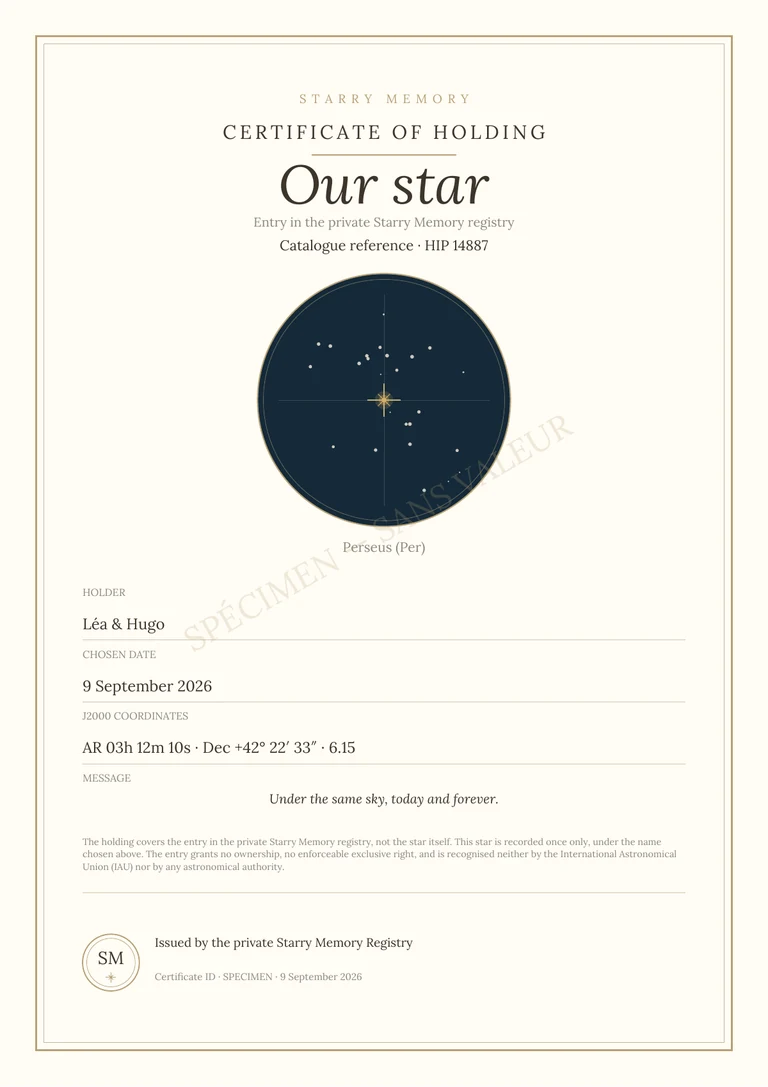
✦ Personalised star certificate
For a person rather than a date: give them a star
A personalised certificate with a QR code: one smartphone scan shows the star in 3D, then its direction in the real sky.
- Choose a real star and its name
- Scan the certificate’s QR code, no app needed
- Find it in the sky with your smartphone
From €8.91 · PDF to download as soon as you pay
Symbolic dedication in the private Starry Memory registry. Depending on its brightness and the weather, you’ll see it with the naked eye, with binoculars, or find its direction.
Name a star: the certificate in detail
Rather the sky of a date and place? Create a star map · HD file €3.99