Valentine’s Day · star certificate
Name a star for Valentine’s Day
For Valentine’s Day, pick a real star from the Hipparcos catalogue, give it a name only the two of you would understand and date it to the day your story started: the night you met, the first date, the first kiss. The PDF certificate is ready to download as soon as your payment is confirmed, so all that is left is printing it, sliding it into an envelope and stepping outside together.
Symbolic dedication in the private Starry Memory registry · from €8.91 · PDF to download as soon as you pay.
Giving a star: how it works
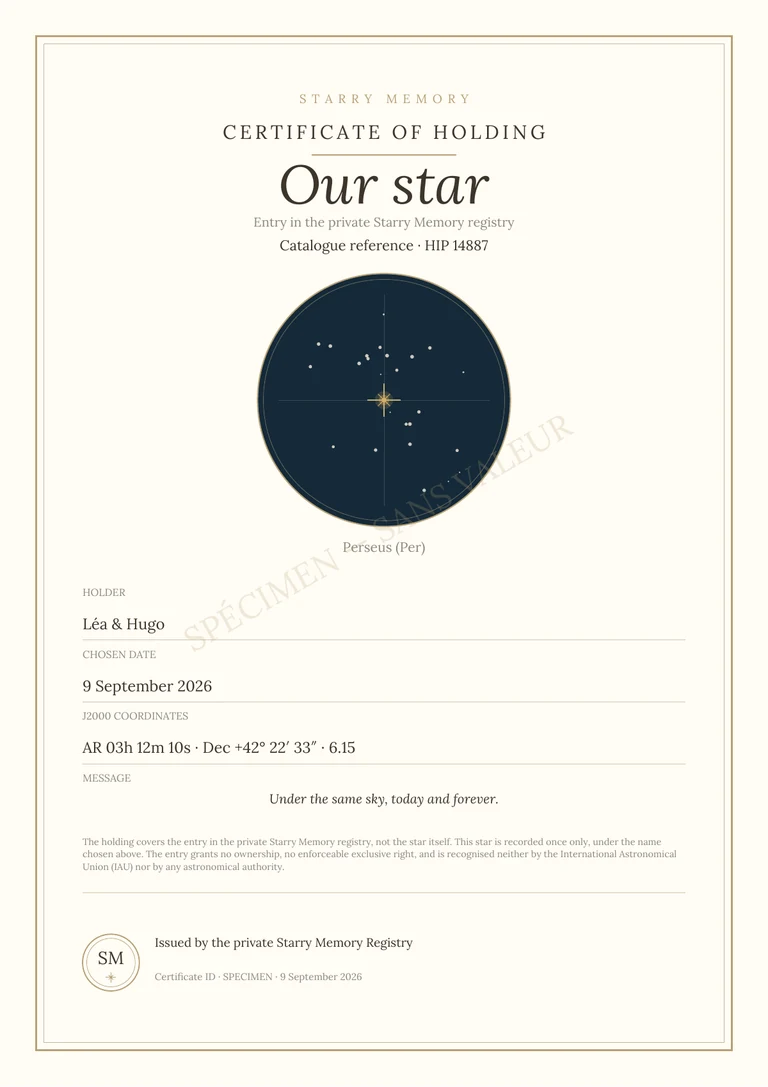
A real star, its personalised PDF certificate and a QR code to find it in the sky.
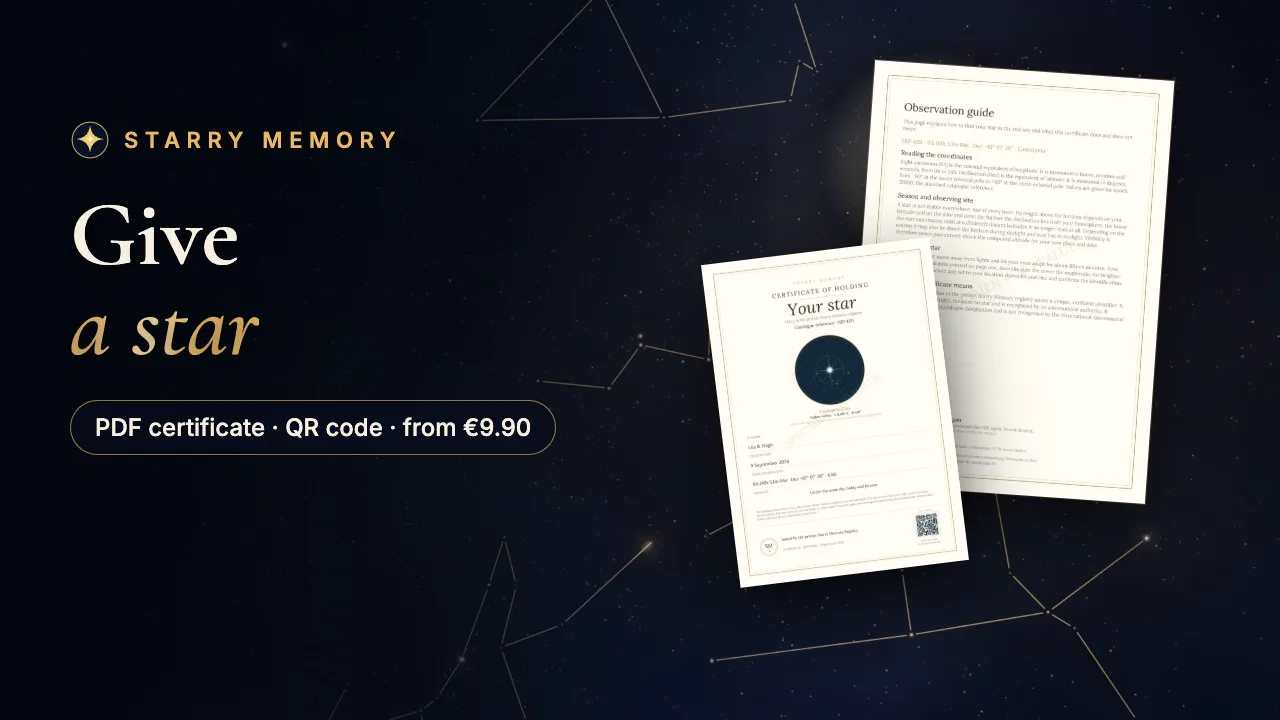
It is a symbolic dedication in the private Starry Memory registry, from €8.91. Nobody can buy a star, and the name you choose does not replace its scientific designation. What you give is a date that belongs to you both, a few honest words and an excuse to look up on a February evening.
Choose the date that matters to you
Valentine’s Day is only the day you hand the certificate over. The date printed on it is entirely up to you: the evening you met, an awkward first date, the first kiss, the day you got the keys to your first flat, a proposal. That detail usually lands first, because your partner recognises the date before reading the star’s name.
Not sure of the exact day? Scroll back through old messages or the photos on your phone rather than guessing. An approximate date can also live in the message, something like “one rainy evening in October, six years ago”. The date has no astronomical meaning: it changes neither the star nor its position, it simply tells your story.
Ideas for the star’s name and your message
The dedication has three separate fields: the star’s name (up to 32 characters), the recipient (60 characters) and the message (280 characters, two or three sentences). Keep the name short and easy to say out loud: a nickname nobody else uses, your two first names blended together, the street or café where it all started, a line from a song you both know by heart.
For the message, one precise memory says more than a grand promise. A few starting points to rewrite with your own details:
The recipient and the message stay private: they appear on your certificate, never on the star’s public page. Only the star’s name can be shown publicly, and only if you switch that option on; it is off by default. Leave out anything personal your partner would not want to see online.
Making the evening of 14 February special
A file turns into a real present once you give it a moment of its own. A few ideas that cost nothing extra:
- Print both A4 pages on slightly heavier matte paper, fold them and seal them in an envelope with only the star’s name written on the front.
- Leave the envelope by their plate at dessert, or slip it into a coat pocket before you head out.
- After dinner, go outside for ten minutes: the second page, the finder guide, shows the constellation and the direction to face.
- Scan the QR code together: the star’s page opens in 3D in the phone’s browser, no app needed, then helps you point the phone at the real sky using its motion sensors.
- Spending the day apart? Send the PDF yourself and call at the moment the file is opened.
The sky on 14 February 2027: which star to choose?
Valentine’s Day 2027 falls on a Sunday. Around 9 pm from Britain, Ireland, mainland Europe or the northern United States, the winter sky is at its best: Orion due south, Taurus and Gemini on either side, bright Capella almost overhead. The table shows how many stars of our registry lie in each constellation and how many reach magnitude 6, the naked-eye limit under a dark sky; each link preselects an available star.
Two very bright points rise in the east that evening, in Leo: Jupiter, at opposition on 11 February 2027 (the evening of the 10th in the Americas), and Mars, at opposition on 19 February. They are planets and cannot be dedicated, but they make good landmarks. The Moon reaches first quarter on the 14th and sits in Taurus, high in the south-west after dark; it stays up until the small hours and washes out the faintest stars.
| Constellation | 14 February 2027, around 9 pm (Europe and North America) | Stars in the registry | Naked-eye stars among them | Choose a star |
|---|---|---|---|---|
| Orion | Due south, at its highest of the evening | 20 | 15 | Choose a star |
| Taurus | High in the south-west, with Aldebaran, the Pleiades and the Moon that night | 20 | 15 | Choose a star |
| Gemini | High in the east-south-east, around Castor and Pollux | 16 | 12 | Choose a star |
| Auriga | Close to overhead, around bright Capella | 16 | 12 | Choose a star |
| Leo | Still low in the east, with Jupiter and Mars nearby | 29 | 23 | Choose a star |
| Cassiopeia | Half-way up in the north-west, a W of stars | 16 | 7 | Choose a star |
Catalogue figures as of this page’s last update: a star that has already been dedicated is no longer offered, and real availability is shown when you choose.
Positions computed with Astronomy Engine for mid-northern latitudes around 9 pm local time; they shift a little with your location. Visibility is never guaranteed: clouds, moonlight, street lighting and the star’s brightness decide what you see. If the sky lets you down, the finder guide and the QR code still show the direction.
Ready even on the evening of the 14th
The certificate is a digital product. As soon as the payment is verified and the star is assigned in our registry, the two-page A4 PDF appears on the confirmation page: the numbered certificate, then the finder guide. There is no last posting date and no parcel to wait for; you can prepare it on the 13th or late in the afternoon of the 14th, as long as a printer is within reach.
Nothing is posted and nothing is sent automatically to your inbox: download the PDF straight away and keep its private link to yourself, as it also manages whether the star’s name is shown publicly. Give the file or the printout, not that link. The full preview is free before you pay, which is the moment to check the name, the date and every word of the message.
What it is, and what it is not
It is a symbolic dedication: a real star, identified by its HIP number, assigned to a single order in the private Starry Memory registry, with the name, date and message you chose. The certificate comes in three colours at the same price: ivory, midnight blue or pink, and also lists the star’s coordinates and astronomical data.
It is not a deed of ownership, and it is not a name recognised by the International Astronomical Union, with which Starry Memory has no affiliation: the star keeps its designation in scientific catalogues, and exclusivity only applies inside our own registry. Nor is it a promise that you will see it: depending on its brightness, you may need a dark sky or binoculars.
Prefer the whole sky of the night you met?
The certificate puts one star in the spotlight. To show the entire sky of a particular evening, above the town where you met for instance, the Starry Memory personalised star map is a separate product with its own designer, as a digital file or a print. For a print or a frame, the delivery time is shown before you pay. The two gifts work well together but are not linked: buying one does not unlock the other.
Frequently asked questions
Can I order on 14 February and give it the same evening?
Yes. The PDF is available as soon as the payment is verified and the star assigned, at any hour, including on Valentine’s Day itself. Just allow time to check the preview and print it.
Which date should go on the certificate?
Whichever you like: the day you met, the first kiss, the first date or 14 February itself. The date tells your story; it does not change the star or its position.
Will we be able to see the star on Valentine’s night?
That depends on its brightness, the weather, the Moon and where you are. Stars of magnitude 6 or brighter can be seen with the naked eye under a dark sky; fainter ones need binoculars. The finder guide and the QR code show where to look, without guaranteeing visibility.
Will astronomers recognise the name we choose?
No. It is a dedication in the private Starry Memory registry. The star names used by scientists are the responsibility of the International Astronomical Union, which does not sell any.
How much does a Valentine’s star cost?
From €8.91. The price depends on the tier you choose, in other words on how bright the star is and what type it is; our pricing page lists every tier.
✦ Personalised star certificate
For your story, give them a star
A personalised certificate with a QR code: one smartphone scan shows the star in 3D, then its direction in the real sky.
- Choose a real star and its name
- Scan the certificate’s QR code, no app needed
- Find it in the sky with your smartphone
From €8.91 · PDF to download as soon as you pay
Symbolic dedication in the private Starry Memory registry. Depending on its brightness and the weather, you’ll see it with the naked eye, with binoculars, or find its direction.