✦Starry Memory
Which constellations are visible from Hamilton?
Use the free local tool
This page provides a result prefilled with the place and coordinates. The calculations and phone gyroscope work without an order; the HD poster remains optional. See the Hamilton constellation table
A latitude-based guide with transit altitude, season and circumpolar status
Not every constellation rises from every latitude. This guide compares the representative declination of well-known constellations with the latitude of Hamilton. It shows which patterns can clear a practical horizon, how high they culminate and which northern or southern groups stay circumpolar.
Why choose Starry Memory
- Latitude, not guesswork — 20 catalogue constellations clear the 12° transit-altitude screen at the latitude of Hamilton.
- GPS · IANA reference — Exact reference: Waikato Region, 37.7833° S, 175.2833° E, Pacific/Auckland.
- Free tool — The city-specific tool works free in the browser and does not create an order.
- Transparent limits — Weather, light pollution and local obstructions are stated as limits instead of being hidden.
From Hamilton, latitude decides how high each familiar pattern can climb above an ideal horizon. Its verifiable starting point is GeoNames 2190324, 37.7833° S, 175.2833° E, in timezone Pacific/Auckland.
Latitude-screened constellations for Hamilton
Each entry below gives an approximate maximum altitude at meridian transit and a practical season; an asterisk means circumpolar in this simplified centroid model: Crux: 67.8°, all year *; Carina: 67.8°, all year *; Pavo: 62.8°, all year *; Hydrus: 57.8°, all year *; Octans: 45.8°, all year *; Centaurus: 80.8°, autumn; Phoenix: 79.8°, spring; Scorpius: 78.2°, winter; Sagittarius: 77.2°, winter; Canis Major: 72.2°, summer; Virgo: 56.2°, autumn; Aquila: 52.2°, winter; Orion: 47.2°, summer; Leo: 37.2°, autumn. This is a planning guide, not a promise that every star will be visible from a bright street. Date, hour, local obstructions and light pollution still matter. The live sky tool performs the date-specific projection that a static latitude table cannot.
Hamilton's verifiable local record
Calculation identity: GeoNames 2190324 · city Hamilton · region Waikato Region · country New Zealand · national selection rank 4 · reference population 192,100 · source elevation —. Spatial fingerprint: latitude -37.78333 · longitude 175.28333 · south hemisphere · timezone Pacific/Auckland · celestial-pole altitude 37.8°. Seasonal signature: longest night in June, 14 h 36 · shortest night in December, 9 h 24 · range 5.20 hours. Meridian star markers: Crux 67.8° * · Carina 67.8° * · Pavo 62.8° * · Hydrus 57.8° * · Octans 45.8° * · Centaurus 80.8°. Nearby catalogue cities: Tauranga 78 km · Auckland 114 km · Wellington 392 km. First regional eclipse shortlist: 2027-07-18 Penumbral lunar eclipse 16:04 UTC · 2027-08-17 Penumbral lunar eclipse 07:14 UTC · 2028-07-06 Partial lunar eclipse 18:20 UTC. Together these values form the local evidence record for the “constellations” page; they change with place and remain separate from real weather.
Hamilton compared with nearby catalogue cities
1. Hamilton → Tauranga: 78.4 km · Δlat +0.097° · Δlon +0.883° · Δpole -0.1° · timezone Pacific/Auckland = Pacific/Auckland · longest night June 14 h 35 | 2. Hamilton → Auckland: 113.7 km · Δlat +0.935° · Δlon -0.520° · Δpole -1.0° · timezone Pacific/Auckland = Pacific/Auckland · longest night June 14 h 31 | 3. Hamilton → Wellington: 392.0 km · Δlat -3.503° · Δlon -0.508° · Δpole +3.5° · timezone Pacific/Auckland = Pacific/Auckland · longest night June 14 h 58. Monthly night comparison with the nearest catalogue reference — January: Hamilton 9 h 40 / Tauranga 9 h 40 / Δ -0.01 h · February: Hamilton 10 h 35 / Tauranga 10 h 36 / Δ -0.01 h · March: Hamilton 11 h 43 / Tauranga 11 h 43 / Δ +0.00 h · April: Hamilton 12 h 59 / Tauranga 12 h 59 / Δ +0.00 h · May: Hamilton 14 h 02 / Tauranga 14 h 02 / Δ +0.01 h · June: Hamilton 14 h 36 / Tauranga 14 h 35 / Δ +0.01 h · July: Hamilton 14 h 22 / Tauranga 14 h 22 / Δ +0.01 h · August: Hamilton 13 h 28 / Tauranga 13 h 28 / Δ +0.00 h · September: Hamilton 12 h 14 / Tauranga 12 h 14 / Δ +0.00 h · October: Hamilton 11 h 00 / Tauranga 11 h 00 / Δ +0.00 h · November: Hamilton 9 h 55 / Tauranga 9 h 56 / Δ -0.01 h · December: Hamilton 9 h 24 / Tauranga 9 h 25 / Δ -0.01 h. For constellation screening, latitude difference becomes a meridian-altitude difference; a small change is reported as small rather than exaggerated for local copy.
The astronomical fingerprint of Hamilton
Hamilton is represented by 37.7833° S, 175.2833° E, in Waikato Region, using the IANA zone Pacific/Auckland. This is a mid-latitude viewpoint: the relevant celestial pole stands about 37.8° above its horizon. GeoNames record 2190324 supplies the geographic reference; its population field is 192,100 and is used for catalogue selection, not presented as a live census. No source elevation is used, so a flat horizon remains the transparent default.
Twelve monthly light estimates for Hamilton
The following pairs are approximate daylight / night duration around the 15th of each month: January: 14 h 20 / 9 h 40; February: 13 h 25 / 10 h 35; March: 12 h 17 / 11 h 43; April: 11 h 01 / 12 h 59; May: 9 h 58 / 14 h 02; June: 9 h 24 / 14 h 36; July: 9 h 38 / 14 h 22; August: 10 h 32 / 13 h 28; September: 11 h 46 / 12 h 14; October: 13 h 00 / 11 h 00; November: 14 h 05 / 9 h 55; December: 14 h 36 / 9 h 24. The longest estimated night in this model is June at 14 h 36; the shortest is December at 9 h 24. “Night” here is the complement of daylight on a flat horizon. Civil, nautical and astronomical twilight are not interchangeable, and weather is not predicted by this table.
What the calculation does — and does not claim
Coordinates, date and local time feed the same astronomical workflow used by the poster. The HYG catalogue provides star entries, while Astronomy Engine calculates moving bodies. The page does not claim that city-centre coordinates equal a hospital, venue or home: selecting an autocomplete suggestion replaces the shortcut with that location. It also separates astronomical geometry from weather and light pollution, so a correct map never becomes a claim that the ground-level sky was cloudless.
Free gyroscope first, optional poster second
On a compatible phone, the gyroscope turns the calculated sky into a movable window: tilt and rotate to explore, with star names shown beside key points. That experience is free. If a date deserves a keepsake, the same place can continue into the editor. The protected preview remains watermarked before payment; the €3.99 purchase unlocks the 4960 × 7016 px, 300 DPI file. Physical formats appear only when availability, delivery supplement and timing can be checked for the destination. Checkout is in euros; the card issuer shows the current conversion to New Zealand dollars (NZD).
Frequently asked questions
Why use a 12° altitude threshold?
It removes patterns that only graze an ideal horizon. 20 catalogue groups pass that screen here, but local hills and buildings can require a higher threshold.
Can I replace the centre of Hamilton with an exact address?
Yes. Choose the intended autocomplete suggestion; its coordinates replace the city shortcut. Unselected free text is never silently sent to a default city.
Is the Hamilton tool free?
Yes. The local calculation, tables and gyroscope exploration can be used without payment. Only the unlocked HD poster is paid.
Does this guarantee clear-sky visibility?
No. The calculations describe geometry. Cloud, terrain, buildings and light pollution can change what a person sees from the ground.
Do I have to buy a poster?
No. The tool stands on its own. If wanted, the watermark-free 4960 × 7016 px, 300 DPI file costs €3.99. Checkout is in euros; the card issuer shows the current conversion to New Zealand dollars (NZD).
See the Hamilton constellation table
Turn a night under the stars into a gift
Keep exploring for free. When a night means something to you, choose how to remember it.
Keep the whole sky
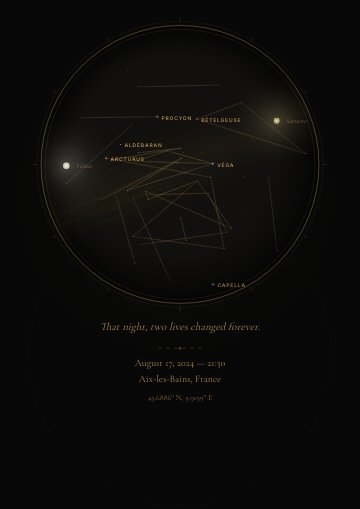
A first date, a birth, a wedding or tonight: create a star map for your chosen place and date, with your own words.
Example design — personalise your own sky in the creator.
Give one star a special meaning
Choose a catalogue star and personalise its PDF certificate. After purchase, your private order link opens a guide to its calculated direction in the sky.
A compatible phone is recommended for gyroscope guidance. Visibility depends on your location, time, weather and the star’s brightness. The certificate records an entry in the private Starry Memory registry, not ownership of the celestial body.
See also
← Back to Starry Memory